
3I/ATLAS Exhibits Unprecedented Negative Polarization Unlike Any Known Comet or Asteroid
First polarimetric observations reveal interstellar comet 3I/ATLAS displays the deepest negative polarization ever recorded for any Solar System object, suggesting dust particles formed under conditions fundamentally different from our own planetary system.
A Unique Optical Signature
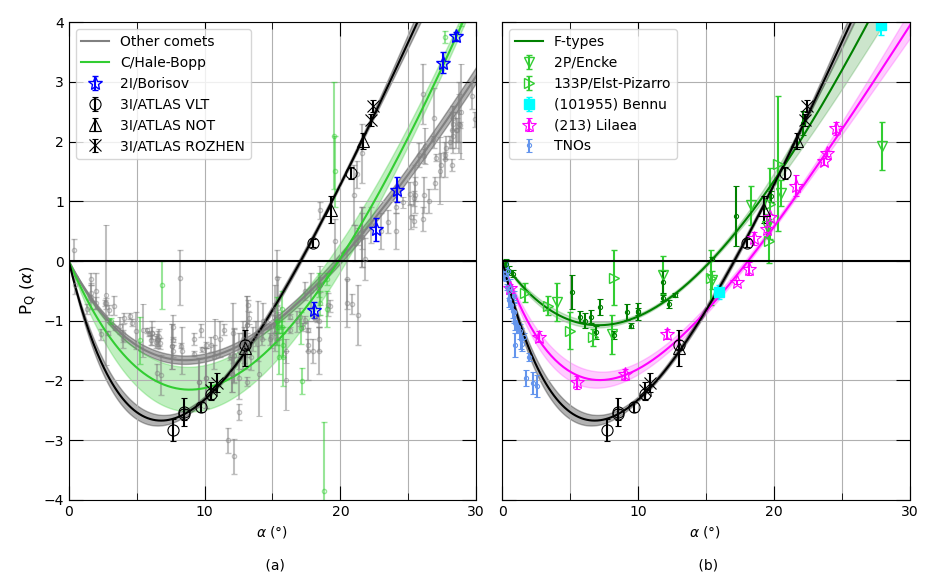
In a groundbreaking discovery published in The Astrophysical Journal Letters, an international team of astronomers has revealed that interstellar comet 3I/ATLAS exhibits a deep and narrow negative polarization branch, reaching a minimum value of -2.7% at a phase angle of 7°, with an inversion angle of only 17°.
This combination is unprecedented among asteroids and comets—including the previous interstellar visitor 2I/Borisov—marking 3I/ATLAS as the first celestial object known to display such extreme polarimetric behavior. The measurements were obtained using the FORS2 instrument at ESO's Very Large Telescope, ALFOSC at the Nordic Optical Telescope, and FoReRo2 at the RCC Observatory.
What Makes This Discovery Extraordinary
"The depth of the negative polarization branch is almost twice as large as rare F-type asteroids and cometary nuclei," explains the research team. "While 3I/ATLAS's inversion angle resembles certain small trans-Neptunian objects, its negative polarization is unprecedented."
This anomaly means the dust particles around 3I/ATLAS must be fundamentally different from the grains shed by familiar comets—perhaps with very fine textures, layered structures, or compositions shaped in an environment far removed from our own.
Understanding Light Polarization in Comets
When sunlight scatters off dust particles in a comet's coma, the reflected light becomes partially polarized—its electromagnetic waves vibrate preferentially in certain directions. The degree and direction of this polarization depends on the size, shape, composition, and structure of the dust grains.
At small phase angles (the angle between the Sun, comet, and observer), most comets show "negative polarization," where light vibrates more parallel to the scattering plane. As the phase angle increases, polarization switches to positive. The angle where this switch occurs is called the inversion angle, and the depth of the negative polarization minimum is a diagnostic of particle properties.
Polarization Minimum
Deepest negative polarization ever measured for any comet, occurring at phase angle 7°
Inversion Angle
Unusually low inversion angle, similar to some trans-Neptunian objects but with much deeper negative branch
Neither High nor Low: A New Class
Comets in our Solar System typically fall into two polarimetric categories: high-polarization comets (with shallower negative branches and higher inversion angles) and low-polarization comets (with moderate negative branches and lower inversion angles). These categories reflect differences in dust particle properties and composition.
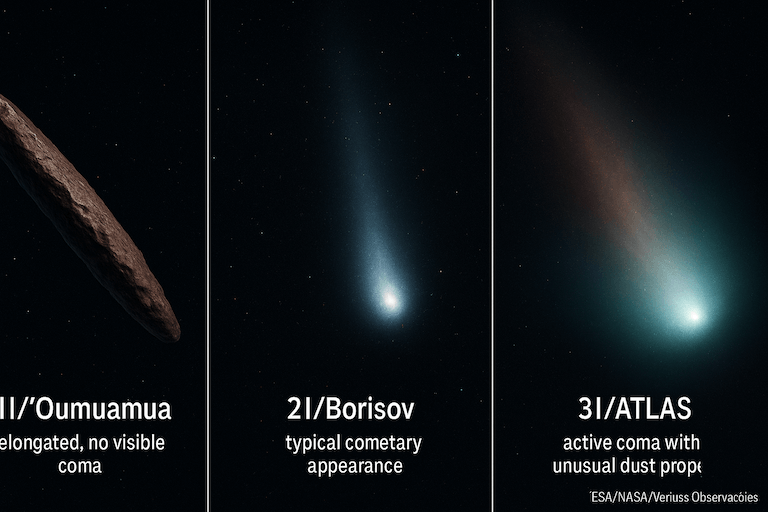
3I/ATLAS fits into neither category. Its polarimetric behavior is significantly different from all known comets—whether interstellar or bound to the Solar System. The combination of extremely deep negative polarization and low inversion angle represents a unique optical signature never before observed.
Polarimetric Comparison with Other Objects
Typical Solar System Comets
Negative polarization: -1% to -1.5% | Inversion angle: 18-22°
2I/Borisov (Previous Interstellar Comet)
Negative polarization: ~-1.2% | Inversion angle: ~21° (similar to Solar System comets)
F-type Asteroids and Cometary Nuclei
Negative polarization: ~-1.4% | Inversion angle: 17-18°
Trans-Neptunian Objects (Pholus)
Low inversion angles with red surfaces, possibly water-ice-bearing
3I/ATLAS (This Discovery)
Negative polarization: -2.7% (unprecedented) | Inversion angle: 17° (unique combination)
What the Dust Reveals
The extreme negative polarization tells scientists that 3I/ATLAS's dust particles possess unusual optical properties. Several possibilities have been proposed:
- Ultra-fine grain textures: Particles with surfaces smoother or rougher than typical comet dust at microscopic scales
- Layered or complex structures: Dust grains with multiple compositional layers or aggregates with unusual internal geometry
- Exotic compositions: Material mixtures or mineral assemblages not commonly found in Solar System comets
- Formation environment indicators: Signatures of temperatures, pressures, or chemical conditions absent in our Solar System's protoplanetary disk
The research team notes that at very small phase angles, the extrapolated slope of the polarization phase curve is consistent with certain small trans-Neptunian objects and Centaur Pholus—objects known to have red, possibly water-ice-bearing surfaces. This provides independent support for spectroscopic evidence suggesting 3I/ATLAS may have a red surface composition.
Implications for Planetary Formation
The discovery adds to a growing body of evidence that 3I/ATLAS formed under very different conditions compared to objects in our Solar System. While 2I/Borisov appeared remarkably similar to Solar System comets in many ways, 3I/ATLAS continues to reveal fundamental differences:
Key Anomalies of 3I/ATLAS
- 1. Extreme negative polarization (-2.7%) unprecedented among comets
- 2. Exceptional water production from 2.9 AU distance (see water detection article)
- 3. Unusual red color similar to outer Solar System objects
- 4. Surface activity level (≥8%) nearly double typical comets
- 5. Age possibly billions of years older than Solar System (estimated 7+ billion years)
- 6. Trajectory suggests origin from extremely distant stellar nursery
"The depth of this negative polarization suggests that 3I/ATLAS's dust formed in an environment with conditions very different from those in our Solar System," notes the research team. "Perhaps the temperature, radiation environment, or chemical composition of its parent star system created dust grains with properties we simply don't see in comets formed around our Sun."
Observational Campaign
The polarimetric observations were obtained pre-perihelion over a phase angle range of 7.7° to 22.4° using some of the world's most sophisticated instruments:
FORS2/VLT
FOcal Reducer and low dispersion Spectrograph at ESO's Very Large Telescope, Chile
ALFOSC/NOT
Alhambra Faint Object Spectrograph and Camera at Nordic Optical Telescope, La Palma
FoReRo2/RCC
Focal Reducer and Roschin Camera at RCC Observatory
The observations required extremely careful photometric calibration and multiple observation epochs to map out the polarization phase curve with sufficient precision to reveal this unprecedented behavior.
Perihelion and Ongoing Studies
3I/ATLAS reached perihelion (its closest approach to the Sun) today, October 29, 2025, at a distance of 1.357 AU (203 million kilometers). This marks the peak of the comet's activity, when solar heating is strongest and outgassing rates reach their maximum.
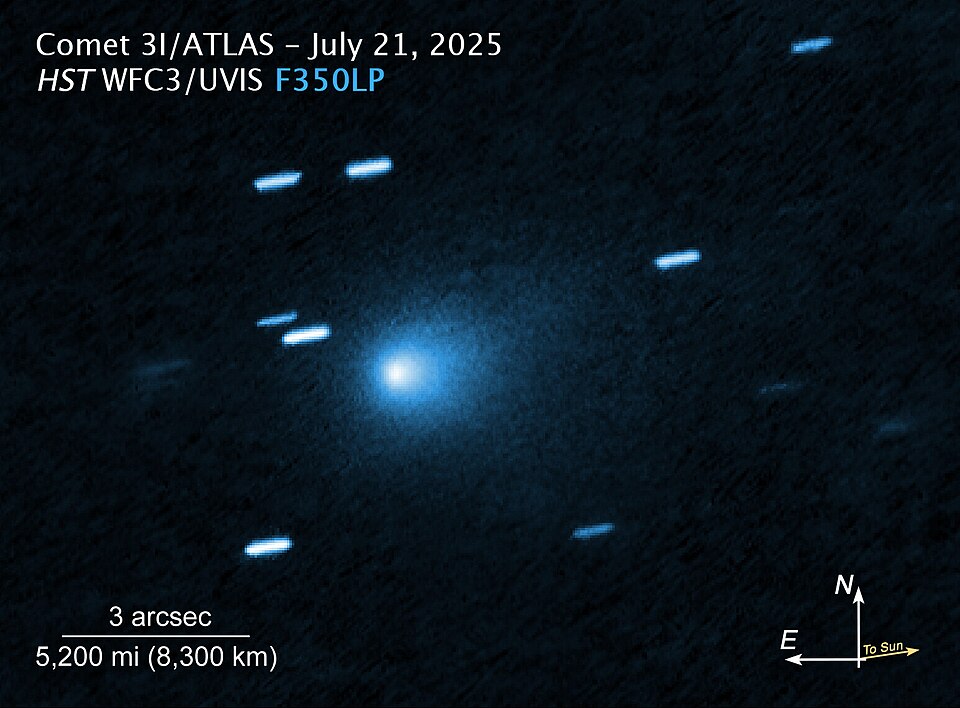
Post-perihelion observations will be crucial for understanding whether the polarimetric properties change as the comet's activity evolves. The International Asteroid Warning Network (IAWN) has initiated a campaign running from November 27, 2025, through January 27, 2026, to coordinate observations and improve astrometric tracking of this unique interstellar visitor.
Upcoming Observation Windows
Each Interstellar Visitor Tells a Different Story
The three confirmed interstellar objects discovered to date—1I/'Oumuamua, 2I/Borisov, and 3I/ATLAS—have each proven dramatically different from one another, challenging our understanding of what "typical" interstellar objects might be:
1I/'Oumuamua was remarkably dry with no detected coma or tail, exhibited non-gravitational acceleration of unknown origin, and had an unusual elongated or pancake-like shape that continues to spark debate about its nature.
2I/Borisov appeared reassuringly familiar—a "normal" comet rich in carbon monoxide with composition and behavior similar to comets from the outer regions of our own Solar System. Its discovery initially suggested that interstellar comets might not be so different from our own.
3I/ATLAS has shattered that assumption with its unprecedented negative polarization, exceptional water production from unusual distances, high surface activity, and multiple anomalies suggesting formation conditions absent in our Solar System.
The Diversity of Planetary Systems
"With each interstellar visitor proving dramatically different from the last, we're learning that planetary systems can produce a remarkable diversity of objects," explains the research team. "The extreme negative polarization of 3I/ATLAS adds to the evidence that conditions in other star systems—the temperatures, compositions, radiation environments, and timescales—can differ fundamentally from what we see in our own Solar neighborhood."
As we continue to discover and study more interstellar visitors, each one will provide unique clues about the planetary formation processes operating across our galaxy.
Scientific Publication and Data Availability
The full research findings are available in the peer-reviewed paper "Extreme Negative Polarisation of New Interstellar Comet 3I/ATLAS" published in The Astrophysical Journal Letters (arXiv:2509.05181). The paper presents the complete polarimetric phase curve, detailed analysis of dust grain properties, and comparison with all known Solar System and interstellar objects.
The observations and analysis represent a coordinated effort by astronomers across multiple institutions and facilities, demonstrating the international collaboration required to fully characterize these rare interstellar visitors during their brief passage through our Solar System.