
3I/ATLAS Reaches Perihelion Behind the Sun as Historic Mission Encounters Loom
As interstellar comet 3I/ATLAS reaches its closest approach to the Sun on October 29, it remains hidden behind our star in solar conjunction. But the temporary observation gap sets the stage for unprecedented encounters by NASA's Europa Clipper and ESA's Juice missions in early November.
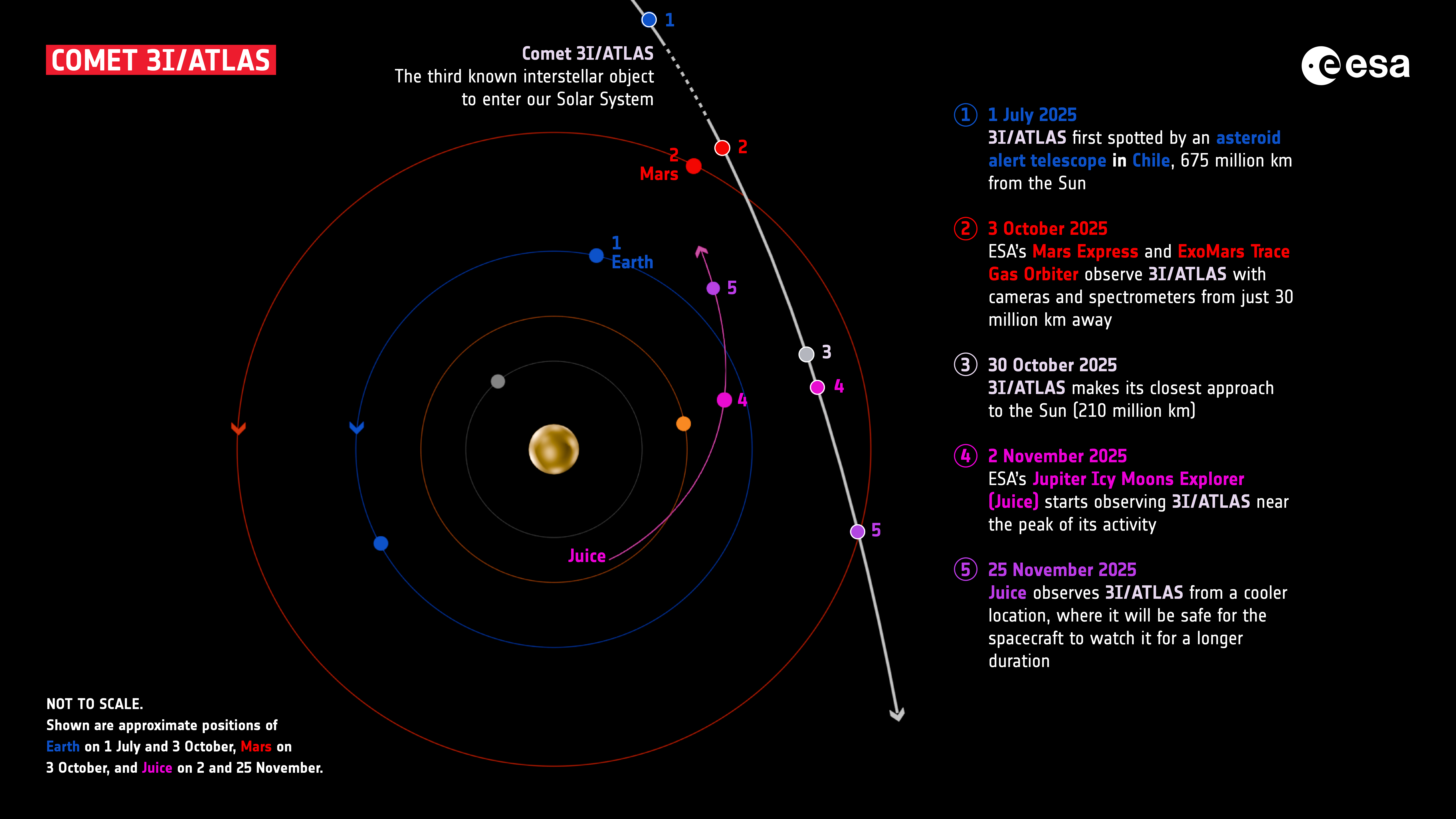
The Missing Comet: Solar Conjunction Explained
If you've been following 3I/ATLAS and wondering why recent observations have gone quiet, there's a simple astronomical reason: the comet has entered solar conjunction, meaning it's positioned on the opposite side of the Sun from Earth's perspective.
On October 21, 2025, 3I/ATLAS entered solar conjunction—just eight days before reaching perihelion. This timing means that the comet's closest approach to the Sun will occur while it's completely hidden from Earth-based telescopes, creating an observation gap from mid-October through early December 2025.
During this period, the comet sits within approximately 10 degrees of solar elongation, making it impossible to observe safely from Earth without risking damage to telescopes and instruments from the Sun's overwhelming brightness.
Perihelion: The Moment of Maximum Activity
On October 29, 2025, 3I/ATLAS will reach perihelion—its closest point to the Sun—at a distance of 1.36 astronomical units (203 million kilometers). This places the comet roughly midway between the orbital paths of Mars and Earth.
Perihelion represents the moment of peak cometary activity. As 3I/ATLAS receives maximum solar heating, sublimation of ices accelerates dramatically, producing the largest and most active coma and tail of its entire solar system passage. Scientists expect water outgassing rates to reach their highest levels during this critical period.
Eight Documented Anomalies at Perihelion
What makes this perihelion passage particularly intriguing is that 3I/ATLAS arrives with eight documented anomalies that distinguish it from typical solar system comets. These include:
- Extreme water activity at large heliocentric distances — substantial outgassing observed at nearly 3 AU from the Sun
- Unusual dust-to-gas ratio suggesting a different formation environment
- Red surface coloration indicating possible organic-rich composition
- Asymmetric light curve with unexpected brightness variations
- Non-gravitational forces affecting its trajectory more than predicted
- Variable coma morphology with irregular activity patterns
- Unique spectral signatures in hydroxyl (OH) emissions
- Differing nucleus properties from typical Oort Cloud comets
How these anomalies manifest during peak solar heating at perihelion remains one of the key scientific questions. Unfortunately, the solar conjunction means that ground-based telescopes will miss this critical moment—making the upcoming spacecraft observations even more valuable.
Historic Encounter: Europa Clipper Crosses the Ion Tail
Just one day after perihelion, a remarkable cosmic coincidence will unfold. From October 30 to November 6, 2025, NASA's Europa Clipper spacecraft—currently en route to Jupiter's icy moon—will pass directly through 3I/ATLAS's ion tail.
This unprecedented encounter offers a unique opportunity for in situ measurements of an interstellar comet's plasma tail. Europa Clipper's suite of instruments, including magnetometers and particle detectors, are perfectly suited to detect and characterize the ionized gases and magnetic field structures within the tail—if solar wind conditions prove favorable.
"This is an unexpected bonus for the Europa Clipper mission. While our primary target is Europa, having the opportunity to sample material from an interstellar visitor is scientifically invaluable. We'll be looking for signatures of the comet's ion tail in our plasma and magnetic field data."
The timing is particularly fortuitous: Europa Clipper will traverse the tail just as 3I/ATLAS emerges from perihelion in its most active state, potentially detecting the freshly sublimated and ionized material from the comet's nucleus.
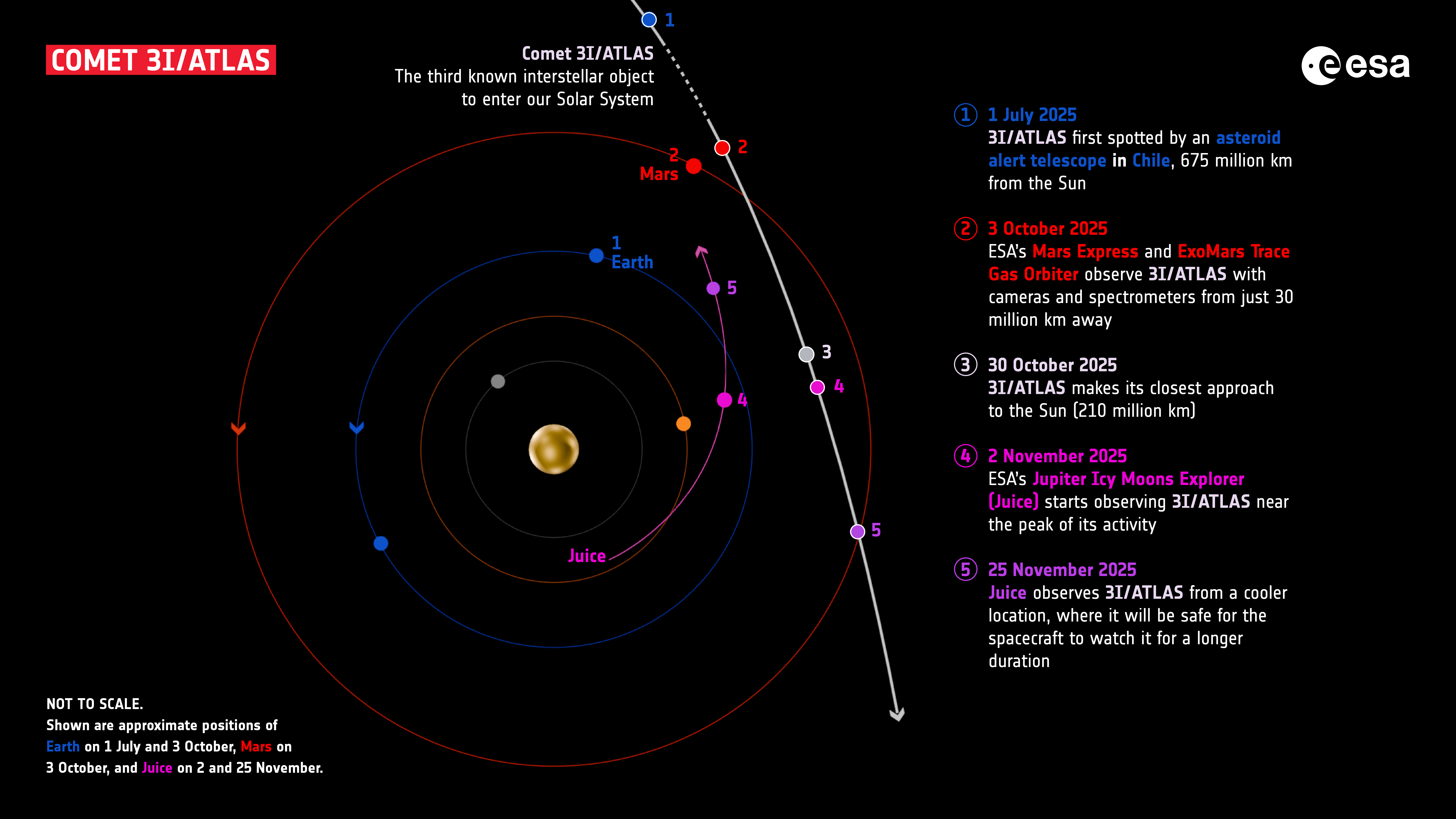
Juice Joins the Campaign
On November 4, 2025, ESA's Jupiter Icy Moons Explorer (Juice) will conduct coordinated observations of 3I/ATLAS from a distance of 64 million kilometers.
Juice will deploy multiple instruments for the observation campaign, including:
- JANUS cameras for high-resolution imaging of the coma and tail structure
- UV spectrograph (UVS) to measure hydroxyl (OH) and oxygen emissions
- MAJIS infrared spectrometer for compositional analysis
- Particle and plasma instruments to characterize the surrounding environment
The coordination between Europa Clipper and Juice is particularly exciting. Both spacecraft carry twin ultraviolet spectrographs, potentially allowing for stereoscopic observations of the comet's extended hydrogen cloud and water production rates from different viewing angles.
However, patience will be required: Juice is currently using its high-gain antenna as a heat shield while traveling through the inner solar system, meaning that data from these November observations won't be downlinked to Earth until February 2026.
Alternative Eyes on the Sky
While ground-based observations are blocked by the Sun, a few space-based platforms can still monitor 3I/ATLAS during this critical period:
- GOES-19 weather satellite can observe the comet from October 18–24, detecting objects down to magnitude 12
- NASA's Parker Solar Probe and ESA's Solar Orbiter offer alternative vantage points away from the Earth-Sun line
- SOHO and STEREO solar observatories may catch glimpses depending on exact positioning
These observations, while limited, help fill the gap in the comet's activity record during this crucial perihelion passage.
When Will We See 3I/ATLAS Again?
After disappearing behind the Sun in mid-October, 3I/ATLAS will emerge from solar conjunction in early December 2025. At that time, it will become visible in the pre-dawn sky just before sunrise, now on its outbound journey from the solar system.
The comet will be less than 30 degrees from the Sun until November 9, 2025, meaning challenging but possible observations may begin in mid-November for professional observatories, with more favorable viewing conditions arriving as December progresses.
By December, 3I/ATLAS will have passed perihelion and begun its long journey back to interstellar space. Observers will have the opportunity to monitor how its activity evolves as it moves away from the Sun's warming influence—providing crucial data on the comet's outgassing behavior and compositional asymmetries.
Scientific Significance
The upcoming November observations by Europa Clipper and Juice represent an extraordinary opportunity in interstellar comet research. For the first time, we'll have spacecraft measuring an interstellar visitor's plasma environment and compositional properties from relatively close range during its most active phase.
These measurements will help answer fundamental questions:
- How does 3I/ATLAS's ion tail composition compare to solar system comets?
- What can the plasma properties tell us about the comet's formation environment?
- How do the documented anomalies manifest during peak activity?
- What is the true water production rate at perihelion?
- Are there unexpected species in the coma that reveal interstellar chemistry?
The answers will shed light not only on 3I/ATLAS itself but on the broader population of interstellar comets and the planetary systems from which they originate—potentially billions of light-years away and billions of years in the past.
Looking Ahead
As 3I/ATLAS silently reaches perihelion behind the Sun this week, the stage is set for one of the most exciting chapters in its story. The Europa Clipper tail crossing and Juice observations in early November promise unprecedented insights into this visitor from beyond our solar system.
While amateur astronomers and most professional observatories must wait until December to view the comet again, the spacecraft observations will ensure that this critical phase of 3I/ATLAS's journey doesn't go unrecorded. When the data arrives in early 2026, we may finally understand what makes this interstellar wanderer so unique.
For now, 3I/ATLAS travels alone through the inner solar system, bathed in maximum sunlight, its secrets preserved for the spacecraft encounters to come.