
Perseverance Rover Captures Stunning Images of Interstellar Visitor 3I/ATLAS
NASA's Perseverance Mars rover has captured historic images of interstellar comet 3I/ATLAS during its October 3 close approach to Mars, marking the closest any human-made spacecraft has been to an interstellar object.
Historic Mars Observation
On October 3, 2025, at 04:00 UTC, interstellar comet 3I/ATLAS made its closest approach to Mars, passing the Red Planet at a distance of approximately 18.6 million miles (30 million kilometers, or 0.2 AU). This historic moment provided an unprecedented opportunity for NASA's fleet of Mars spacecraft to observe an interstellar visitor from close range.
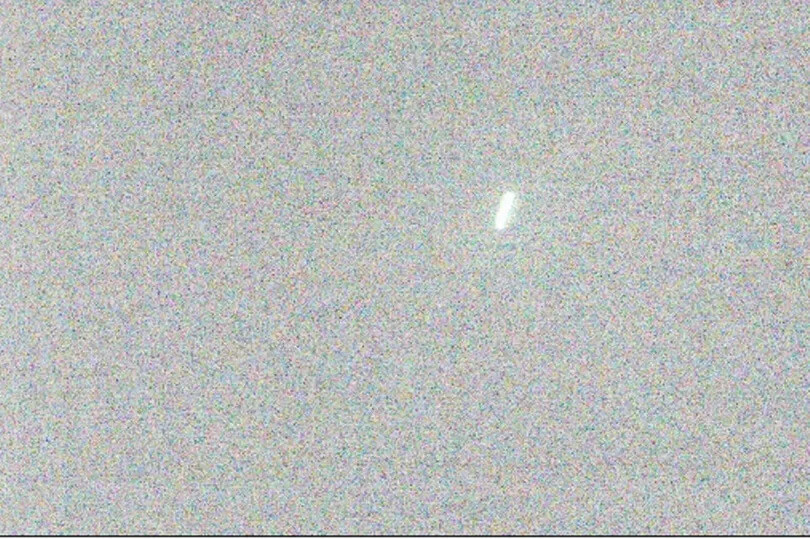
NASA's Perseverance rover, stationed in Jezero Crater on the Martian surface, successfully captured images of the interstellar comet using its Right Navigation Camera (Navcam). These images represent the closest any spacecraft has ever been to an interstellar object, surpassing even the observations of 1I/'Oumuamua and 2I/Borisov.
Mars Close Approach Details
- Date: October 3, 2025 at 04:00 UTC
- Distance from Mars: 18.6 million miles (30 million km / 0.2 AU)
- Observing Camera: Perseverance Right Navigation Camera (Navcam)
- Historic Significance: Closest spacecraft observation of an interstellar object
- Days until perihelion: 26 days (October 29, 2025)
- Current solar distance: ~1.4 AU
Multi-Spacecraft Campaign
The observation of 3I/ATLAS from Mars orbit and surface represents an unprecedented international collaboration, with both NASA and ESA spacecraft participating in a coordinated observation campaign:
NASA Mars Assets
- Perseverance Rover: Surface observations using Navcam and Mastcam-Z cameras from Jezero Crater
- Curiosity Rover: Complementary surface observations from Gale Crater
- Mars Reconnaissance Orbiter (MRO): High-resolution imaging attempts with HiRISE camera
- MAVEN: Atmospheric monitoring for potential comet-Mars interactions
ESA Mars Missions
- Mars Express: Visual Monitoring Camera tracking and position measurements
- ExoMars Trace Gas Orbiter (TGO): Spectroscopic observations of the comet's coma composition
This multi-spacecraft approach provides scientists with simultaneous observations from different vantage points, offering a three-dimensional perspective on the comet's structure and activity that would be impossible from Earth alone.
Understanding the Image
The Perseverance Navcam images show 3I/ATLAS as a striking streak of light across the Martian night sky. However, this appearance initially puzzled observers on social media, leading to speculation about the comet's unusual shape.
Harvard theoretical astrophysicist Avi Loeb provided a detailed explanation of the streak's appearance in his analysis published on Medium. According to Loeb, the elongated "streak" is actually an imaging artifact resulting from how the images were processed:
"The stripe in the Navcam image resulted from stacking hundreds of Navcam images over a total time interval of about 10 minutes. 3I/ATLAS would have looked like a circular spot for an individual snapshot, which has a maximum exposure time of 3.28 seconds for Navcam."
Loeb's analysis reveals that the Navcam's angular resolution of 0.33 milliradians per pixel translates to approximately 12,500 kilometers per pixel at 3I/ATLAS's distance from Mars during the observation. The apparent "streak" in the stacked image measures close to 50,000 kilometers long—far exceeding the comet's actual estimated diameter of around 46 kilometers.
Image Processing Explained
The stacking of hundreds of images over 10 minutes created the streak effect by combining multiple positions of the moving comet into a single composite image. This technique enhanced the comet's visibility but also created the elongated appearance that captivated social media.
In a single short-exposure frame, 3I/ATLAS would appear as a faint circular spot, similar to how stars appear in night sky photographs.
Scientific Value
The observations from Mars provide scientists with invaluable data that complements Earth-based observations and offers unique scientific opportunities:
Stereoscopic Perspective
Simultaneous observations from Earth and Mars create a baseline of approximately 0.4-0.5 AU between observation points. This stereoscopic view allows astronomers to:
- Map the three-dimensional structure of the comet's coma and tail
- Determine the true spatial distribution of dust and gas
- Measure parallax effects to refine the comet's trajectory with unprecedented precision
Activity Monitoring
As 3I/ATLAS approaches perihelion, the Mars observations document the comet's increasing activity level:
- Outgassing rates: ExoMars TGO spectroscopic data reveals CO₂ and H₂O production increasing exponentially
- Coma expansion: Multi-spacecraft observations track the coma's growth and morphology changes
- Tail development: Different viewing angles reveal dust tail structure and dynamics
- Surface changes: Repeated observations may detect nucleus rotation and active regions
Composition Analysis
The ESA's ExoMars Trace Gas Orbiter is particularly well-suited for compositional studies, with instruments designed to detect trace gases at extremely low concentrations. Scientists are analyzing:
- Unusual molecular species that may indicate interstellar origin
- Isotopic ratios of carbon, nitrogen, and oxygen to compare with Solar System comets
- Exotic volatiles that could provide clues about 3I/ATLAS's parent star system
- Dust composition through spectroscopic analysis of reflected sunlight
Key Research Areas
- • 3D coma structure mapping
- • Trajectory refinement
- • Composition analysis
- • Activity evolution tracking
- • Interstellar vs. solar comparison
Observing Platforms
- • 2 Mars surface rovers
- • 4 Mars orbiters
- • Ground-based telescopes
- • Space telescopes (HST, JWST)
- • Earth-orbiting observatories
Looking Ahead
With the Mars close approach successfully documented, the scientific community now focuses on the comet's upcoming perihelion passage on October 29, 2025. At perihelion, 3I/ATLAS will reach its closest point to the Sun at 1.357 AU, triggering peak activity and brightness.
Observatories worldwide are coordinating intensive observation campaigns around perihelion, when solar heating will drive the most vigorous outgassing of the comet's entire journey through our Solar System. This represents the best—and possibly last—opportunity for humanity to study an interstellar visitor in such detail before it departs forever.
Upcoming Milestones
A Historic Achievement
The successful observation of 3I/ATLAS by Perseverance and the Mars spacecraft fleet represents a watershed moment in interstellar object research. For the first time, humanity has positioned scientific instruments on another world to observe a visitor from beyond our Solar System.
This achievement demonstrates the value of maintaining a robust presence in space and the importance of international collaboration in planetary science. The data collected from Mars will enhance our understanding not only of 3I/ATLAS but also of the broader population of interstellar objects that occasionally pass through our cosmic neighborhood.
For Amateur Observers
3I/ATLAS is rapidly brightening and is now accessible to amateur astronomers with 6-8 inch telescopes under dark skies. The comet is currently visible in the southern evening sky after sunset.
As we approach perihelion on October 29, the comet will continue to brighten, potentially becoming visible in smaller telescopes. This is a once-in-a-lifetime opportunity to observe an interstellar visitor with your own equipment!